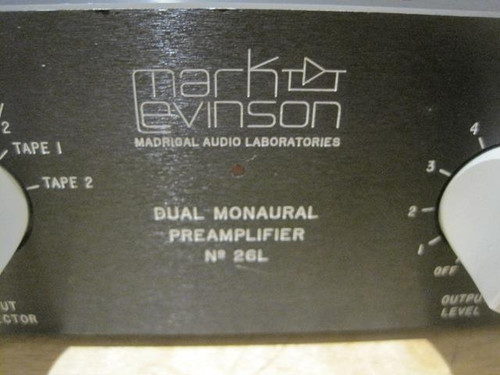
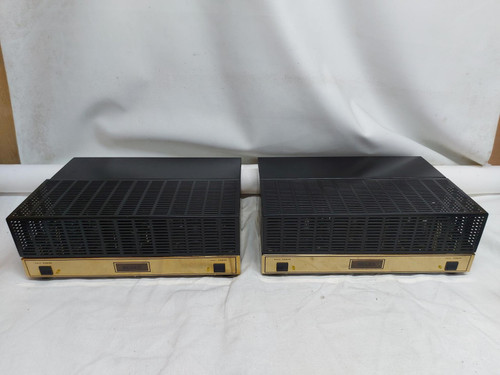
Mark Levinson ML3 Power Amplifier
Very good cosmetically and full working order.
This stereo power amplifier was developed as an answer to the question of how much sound quality can be refined while maintaining a high output that can drive all kinds of speakers.
The power supply employs a large toroidal transformer with a capacity of 1.2 kva per channel and a large-capacity capacitor, realizing the capability of sending 45 v pulses at a high current of 30A per channel at peak.
The interior is completely monaural construction, and high precision parts are carefully selected for use.
Especially, very thick pure copper cables are used for internal wiring.
The damping factor can be switched to 3 levels of NOM/LOW/HIGH by the switch on the rear panel, further enhancing the adaptability to speakers.
Type Stereo power amplifier
Circuit Class AB operation
Rated output
(according to the FTC Act) 200W + 200W (8 ω, both channel drive, continuous sine wave
20 Hz to 20 kHz, THD 0.2% or less)
Maximum output voltage 45 v (per channel)
Maximum output current 30A (per channel)
Input impedance 20k Ω
Input sensitivity 1V
Gain 32dB
Pwer 100 VAC, 50Hz/60Hz
Power consumption 180W (idle)
2.5 kW (2 Ω load, non-clip maximum output)
External dimensions Width 483x Height 266x Depth 620 mm
rformance Metrics
The Mark Levinson ML-3 power amplifier delivers 200 watts per channel into 8 ohms, doubling to 400 watts per channel into 4 ohms and 800 watts per channel into 2 ohms, all specified as continuous sinewave power from 20 Hz to 20 kHz.[2][4] These output levels are achieved with total harmonic distortion (THD) ≤ 0.2% at rated power into 8 ohms and ≤ 0.4% at 400 watts into 4 ohms.[4]
The amplifier's frequency response is flat within ±0.1 dB from 20 Hz to 20 kHz at 1 watt into 8 ohms, maintaining this linearity even under load.[4] Maximum output capabilities include 45 volts peak and 30 amperes peak current, enabling it to handle demanding speaker loads with transient peaks approaching 900 watts into 2 ohms without clipping or damage.[2][4] This high-current design, supported by its robust power supply, contributes to exceptional stability and damping factor greater than 1,000 at 1 kHz and below (adjustable per channel with high, normal, low settings).[4][2]
Due to its fully discrete circuit topology, the ML-3 achieves a low noise floor, providing a clean, quiet background even at low volumes with no audible hum.[4] Later models included features such as adjustable damping factor switches and anti-buzz circuits.[9]
Physical Specifications
The Mark Levinson ML-3 features a substantial chassis designed for dual mono operation, measuring 483 mm in width, 266 mm in height, and 620 mm in depth, which allows for the integration of separate amplification sections for each channel to reduce interference.[9] This large form factor, suitable only for floor placement due to its size, supports the amplifier's high-power capabilities while maintaining structural integrity.[9]
Weighing 54 kg (120 lb), the ML-3's heft reflects its robust construction, including a heavy-duty steel enclosure engineered for vibration damping and overall stability during operation.[9][4] Internal wiring employs very thick pure copper cables, and high-precision components are selected to ensure durability and minimal signal degradation.[1] Prominent short-finned heatsinks are integrated into the design, providing efficient thermal management for the Class AB amplification stages and contributing to the unit's formidable physical profile.[9]
Connectivity on the ML-3 emphasizes reliability and adaptability, with later versions incorporating gold-plated Fischer CAMAC connectors for balanced inputs, prized for their secure, low-impedance connections in professional audio applications.[11] Speaker outputs utilize sturdy binding posts, integrated with a rear-panel damping factor switch offering three settings (nominal, low, high) to optimize performance across various loudspeaker loads.[1] These features, combined with the amplifier's overall build quality, highlight its engineering focus on longevity and sonic precision.[9]
Reception and Legacy
Critical Reception
The Mark Levinson ML-3 received acclaim in professional audio reviews during the early 1980s for its exceptional build quality and sonic performance, positioning it as a benchmark for high-end power amplifiers capable of driving demanding speakers with authority. In a 1984 review for Stereo Review, Julian Hirsch praised the amplifier's "utterly effortless, transparent, smooth, clean, detailed, and realistic" sound, attributing this to its low distortion levels—measuring as little as 0.0006% total harmonic distortion at low power outputs—and robust power delivery, which provided significant dynamic headroom without coloration or strain.[4] Hirsch noted that the ML-3's refined tone, enhanced by a subtle high-frequency rise, offered a non-clinical musicality that elevated even modest sources like FM radio or early Compact Discs to reference quality. Performance was essentially identical to the earlier ML-2.[4]
Comparisons to contemporaries highlighted the ML-3's warmer, more powerful profile relative to pure Class A designs.[4] Similarly, a 2011 Stereophile retrospective described the ML-3 as an archetype of 1980s American high-end audio, valuing its refined quality and sheer power over raw brute force, though noting its massive size and weight as emblematic of the era's no-compromise engineering.[12]
Criticisms centered on practical drawbacks, including its prohibitive cost of $5,400 (plus optional custom cables), which limited accessibility to affluent audiophiles, and its 120-pound weight, requiring two people for installation.[4] Hirsch's review of a mid-run unit reported no such hum or noise.[4]
Collectibility and Modern Use
This amplifier is made of exactly 2 mono amplifiers, each on each side, with the two big (1,2 KVA) toroidal transformers put in the middle of the chassis next to some 36,000µF capacitors (100V). It can output 45 Volts at 30 Amperes: you'd better use fat speakers cable cables.
Pro and Cons
Pro Cons
Stereo, high power. Large and heavy.
Can drive any speaker. Lots (20) output transistors which can be expensive to replace.
An engineer delight :-)
Specifications
Power Output: 200 Watts per channel into 8 Ohms, 20 Hz - 20 Khz, < 0.2% THD.
Input Sensitivity: 1 Volt RMS for 200 Watts into 8 Ohms.
Input Impedance : 20 K Ohm shunted by 250 pf.
Max Power Consumption: 2 Ohm load, both channels just below clipping, 2.5 kW, 200 W at idle.
Weight: 52 Kg (~120 lbs).
Dimensions: 483mm (19") ✕ 266mm (10½") ✕ 620mm (20½")