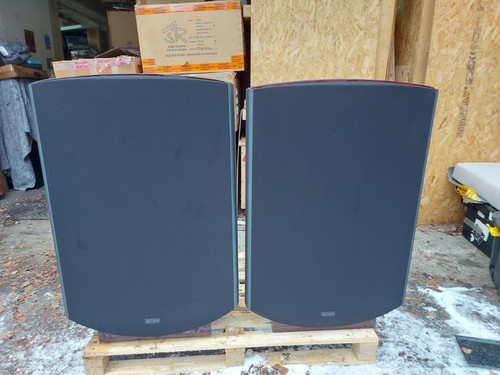
Rosso Fiorentino Pienza Loudspeakers with Stands Boxed
Excellent, in premium leather finish.
Measuring 7.6″ x 9.3″ x 10.3″, the Pienza is most assuredly a mini-monitor. But as I discovered, it’s no small-fry when it comes to sonic performance. The Pienza can throw quite a large and deep soundstage, with plenty of SPL and notably good low-end output for its size.
Within these modest dimensions, the internally damped, rear-ported cabinet is fabricated of solid HDF fiberboard, with aluminum front and side panels for reinforced rigidity. Though this rectangular box is relatively conventional looking, the build-quality is clearly top-notch, as are the tastefully attractive oxblood-red leather side panels found on my review samples, which one sees mirrored on the dedicated stands. (Other finishes are available—see Specs & Pricing below.)
The driver complement comprises a 1″ silk-dome neodymium tweeter and 5.25″ glass-fiber-composite midrange/woofer cone. Magnetically fixed grilles are supplied, but the speakers sound best without them, as the owner’s manual points out.
The manual also suggests equidistant triangular placement between the speakers and the prime listening seat—spot-on both for performance as well as for practicality in my small listening room—which landed the speakers roughly four feet from the rearwall and 18″ or so from the sidewalls.
After settling on this room placement and further breaking-in the speakers, I began my serious listening with an audiophile favorite, one that, no matter how clichéd it may be, remains one of the reference standards for evaluating staging, three-dimensionality, ambience, air, tonal naturalness, and subtle dynamic shadings—the Ernest Ansermet-conducted Royal Ballet Gala Performances. This is one of the greatest RCA recordings of the golden era, available on countless reissues as well as rare original pressings, limited only by how much pain your pocketbook can handle.
The Pienza immediately revealed its myriad strengths: a lovely, easily natural tonal balance wherein brass and winds were richly textured, warm, and convincingly fleshed out, with a fine semblance of instrumental body and of the glorious, seductively silky massed strings on this record. I would say the Pienza’s balance is on the warmer side of the spectrum, which brings a beautiful, if slightly romantic tilt to things.
I also loved the musicality of the Pienza’s silk-dome tweeter. Unlike many metal domes, there was no ringing here. Triangles pinged delicately; cymbals shimmered; flutes and piccolo were sweet; and all were bathed in deliciously warm yet crystalline air.
The Pienza’s staging was impressively open, too, quite box-free in the way that the best mini-monitors can be, with a fine sense of ambience, layered depth, and air “breathing” around individual instruments. And unlike some minis—the original and still magical LS3/5A is a perfect example—the Pienza didn’t present a miniaturized “view” of things. (Like looking through the wrong end of binoculars is how this magazine’s late founder Harry Pearson once accurately described it.)
That said, the Pienza didn’t recreate quite as lifelike a sense of stage and instrumental size as larger cabinets will or as my Magnepan 1.7s do. This was evident on Analogue Productions’ knockout UHQR pressing of Jimi Hendrix’s Axis: Bold as Love (stereo version). Here, the diminutive size of the speakers became evident, the music more clearly sounding as if it was emanating from a smaller point source. And though the dynamic range was impressive enough, the slightly diminished slam did speak to the laws of physics that naturally apply here. Nonetheless, that fine mid/bass driver was fast and taut, and quite seamlessly melded with the tweeter, with no false sense of the trompe l’oreille bass bump found in some minis.
On Analogue Productions’ 45rpm pressing of Thelonious in Action, a killer-sounding live set from 1958, I learned that, as with all speakers, playback volume makes all the difference. On “Blue Monk,” for example, once locked into just the right playback level, the Pienza lets Johnny Griffin’s tenor sax rip—rich, fat, brassy, sassy, reedy, squawking, soaring—as Monk’s funky front-parlor piano plonked away, slightly out of tune, Roy Haynes’ insistently snapping snare drum yapped like a terrier, and Ahmed Abdul-Malik’s bass walked a bouncy tightrope. And then, quite thrillingly, Haynes’ drum solo exploded impressively from these little guys, with plenty of wallop and percussive snap, before the tune rolled back together into a boozy, bluesy conclusion. Very nice.
Switching to the more Zen-like zone of Beethoven’s final, sublime piano Sonata No. 32, as performed by Evgeny Kissin on a live DG release, I felt my shoulders drop and my attention lock in, as I was swept away by this exquisite performance, one of the most complete I know from the dramatic opening chords of the first movement, through the jaunty, ragtime-like middle section of the second, to the sublime conclusion where the music finally slows down and time stands still. The Pienzas did a wonderful job conveying the atmosphere of the live hall and the instrument’s placement within—not, as with studio recordings, placing the piano in your room but placing us in the auditorium. The speakers’ warm accent nicely enhanced the sound of the piano, with a welcome sense of top-to-bottom coherence, layers of harmonic complexity, and good dynamic scale—from the thundering opening bass notes to the delicate trills of the treble keys.
At the end of the day, a checklist of a product’s sonic attributes is one thing, but our emotional response to that sound, to the music, is another—and for me what high-end audio is all about.
A few months back I attended one of the few live concert events I’ve experienced since this pandemic began, and what an experience it was. The brilliant Cécile McLorin-Salvant was in town for a few nights at the SF Jazz Center. Knowing her records well, however, I admit to being unprepared for the emotional impact her art would have in person. McLorin-Salvant is an exceptionally giving performer, who brings a rare grace as well as playfulness to her audience, so much so that I and my guests felt we’d been in the presence of genius, an uplifting spirit.
Her records are uniformly fine sounding, a few so much that they’ve made their way to this magazine’s Super LP List. On her third release, The Window, you’ll find her moving take on “Somewhere” from West Side Story—a wonderful live recording on which she’s accompanied by collaborator-pianist Sullivan Fortner in a breathtaking give and take. All the qualities I’ve attributed to the Pienza were in evidence—wonderful purity, warmth, texture, a more-than-impressive sonic vanishing act. But ultimately it was my getting lost in their performance, actually tearing up at the song’s conclusion, that made me truly appreciate what Francesco Rubenni and his team have accomplished. Bravo!
Specs & Pricing
Type: Two-way rear-ported mini-monitor
Driver complement: 1″ silk-dome neodymium tweeter, 5.25″ glass-fiber composite cone mid/woofer
Frequency response: 50Hz–30kHz
Impedance: 8 ohms nominal, 5 ohms minimum
Sensitivity: 86dB (2.83V/1m)
Recommended amplifier power: 50–100W
Cabinet finishes: “Exclusive RF silky matte black coating,” black carbon-fiber pattern leather (front panel and side stripes)
Dimensions: 7.6″ x 9.3″ x 10.3″
Weight: 20.9 lbs. each