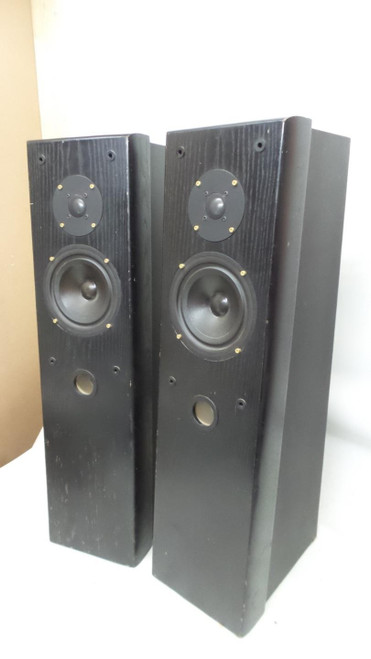
Audium Comp 5 Speakers White
Very good.
he Comp 5 is a 2-way with one solitary driver hacking away at everything above 200Hz; put differently, a widebander with bass augmentation. As the cutaway shows, the widebander loads into a 1-liter tube which assists frequency division such (put simply, smaller volume equals a higher F3) that the crossover slope can remain "relatively gentle" as Urban put it. That separate chamber of course also isolates Audium's small full-ranger from whatever havoc the woofer might wreak inside the main enclosure.
For the latter, Audium relies exclusively on MDF. With 95cm height, the speaker is quite demure and front and rear baffle stretch to merely 12.5cm width though the cheeks bulge outwards. That's not merely attractive but aids in minimizing internal standing waves to attenuate cabinet talk. Two internal braces pursue the same goal. The Comp 5 is fitted with a Nextel-gray plinth whose purpose exceeds cosmetics by creating a constant 2cm gap for the down-firing woofer and thus, an ideally defined radiation resistance as the maker claims. The woofer orientation is further believed to be less critical on room-mode activation to make for broader setup flexibility. Both woofer and widebander are developed in-house and the former is oval. While that's quite rare, here the profile maximizes cone surface with the Comp 5's oval cross section. Urban cites further form factor advantages in the weight/stiffness ratio of the membrane, which is air-dried treated cellulose. This woofer loads into a 26-liter chamber vented out the rear.
This review page is supported in part by the sponsors whose ad banners are displayed below
This review first appeared in the February 2009 issue of fairaudio.de and can be read in its original German version here. It is herewith translated and presented to an English-only audience through a mutual syndication arrangement. As is customary for our own reviews, the writer's signature at review's end has a link below it to his e-mail should you have questions or feedback you wish to send. All images contained in this review are the property of fairaudio.de or Audium. - Ed.
Reviewer: Ralph Werner
Sources: Analog - deck - Acoustic Solid MPX; tone arms - Phonotools Vivid-Two, SME M2 12-inch; carts - Denon DL-103, Ortofon MC Rondo Bronce, Zu Audio DL-103; digital - player - audiolab 8000CD; Computer & Co - Logitech Squeezebox, Readynas Duo NAS-Server, HP Notebook; D/A converters - Aqvox USB2DA-MKII, Benchmark DAC1 USB
Amplification: Phono - Aqvox 2 CI MKII; preamp - Octave HP 300 MK2; power amp - SAC il piccolo monos; integrated - Lua 4040C, Myryad MXI 2080, Octave V 80, Cary SLI-80 [on review]
Loudspeakers: AudiaZ ETA, Sehring 703, Zu Audio Druid mk4 and Presence
Racks & Stands: Creactiv, Taoc, Liedtke Metalldesign Stand, Shale Audio Base
Cables: diverse
Review component retail: €2.000/pr
Lover dearest has greeted more than one audiophile's hopeful lust nod at a man-sized speaker with a resolute "over my dead body only!" exhortation. Hopefully the segment that responds with grim rejection is the great minority. Meanwhile faced with "that li'l one which isn't sooo expensive can come home" before one has even assessed the first note will raise any bona fide high-ender's defensive reflexes: "Sure, not even one meter tall, narrow and with a silver pug nose. Of course she'd love it. My headphones probably have more bloody cone surface. Wait, something's very wrong here. Where the fig are they hiding the other drivers?"
The Audium brand has been revived just recently, May 2008 to be precise, but been in business prior for a while. During the 90s, we've seen speakers and tube amps under its name even though the sphere of familiarity will be quite restricted. The current offering spans three speakers: the monitor Comp 3, the Comp 5 tester and the comp 7 which is a scaled-up 5 in matters of bass. Shortly planned are rear and centers as well as a sub to accommodate home cineasts. As well, the end of the year will see partial or full active drive options for all Comp models. Certain readers will associate the developer Herr Frank Urban with other brands and rightfully so. Besides Audium, Urban deals in SolidTech racks, Visonik speakers (whose puny David has been around forever) and the French Atoll electronics (whose second-from-the-bottom CD 80 we've covered earlier). Urban operates out of Berlin where final assembly of Audium speakers takes place.
Tech
With each picture worth a thousand words, let's kick off in style. The Comp 5 is a 2-way with one solitary driver hacking away at everything above 200Hz; put differently, a widebander with bass augmentation. As the cutaway shows, the widebander loads into a 1-liter tube which assists frequency division such (put simply, smaller volume equals a higher F3) that the crossover slope can remain "relatively gentle" as Urban put it. That separate chamber of course also isolates Audium's small full-ranger from whatever havoc the woofer might wreak inside the main enclosure.
For the latter, Audium relies exclusively on MDF. With 95cm height, the speaker is quite demure and front and rear baffle stretch to merely 12.5cm width though the cheeks bulge outwards. That's not merely attractive but aids in minimizing internal standing waves to attenuate cabinet talk. Two internal braces pursue the same goal. The Comp 5 is fitted with a Nextel-gray plinth whose purpose exceeds cosmetics by creating a constant 2cm gap for the down-firing woofer and thus, an ideally defined radiation resistance as the maker claims. The woofer orientation is further believed to be less critical on room-mode activation to make for broader setup flexibility. Both woofer and widebander are developed in-house and the former is oval. While that's quite rare, here the profile maximizes cone surface with the Comp 5's oval cross section. Urban cites further form factor advantages in the weight/stiffness ratio of the membrane, which is air-dried treated cellulose. This woofer loads into a 26-liter chamber vented out the rear.
While it wouldn't work sans woofer, most the work here is performed by el cutie on top where it is fixed to a bonded and matching Nextel-gray baffle. A 6cm cone diameter won't induce awe but seeing there's no super tweeter assist to 20kHz, it makes for less beaming in the upper octaves where smaller is better. The alu phaser and external baffle are said to optimize constant dispersion. General advantages of widebanders include point-source behavior and, over a broad range, no network filters whose 'take apart' function the ears are supposed to stitch back together again. Nonbelievers casually confess these claims but retaliate by pointing out that widebanders are either too large to make real treble or too small to do bass and to compensate, start shouting in the presence region. Well, "too big" certainly isn't an issue with Audium.
Despite not having to reach deep, one could expect problems with this unit in its lower range since it doesn't offer much cone mass. The Comp driver - um, compensates with an underhung voice-coil geometry. This linearizes its stroke so the coil remains between both Neodymium motor's pole plates. Within its excursion limits, it never leave the homogenous magnetic field. The widebander diaphragm is bamboo-fiber-reinforced paper and untreated unlike the woofer. It's the spider that is treated here to damp spurious resonances. It took one year of calculations and tweakery before Audium signed off on this driver. Let's take it for a spin then.
Strengths
The Comp 5 knows how to deal with impulses. She's quick out of the gate without hesitation but doesn't foreshorten decays. A piano is attack and ring-out, a guitar not merely pluck but tone. Is rhythmic balance a hifi term? Its definition could be music flow without flood. Then what would be flood? Take a really soft valve linked to a watt-sucker speaker with softly hung woofers and voilà, deep sauce. Not here. The Audium Comp 5 clearly marks the musical progression with its transients but connects their dots. There's not skipping as I suspect certain 'super-fast' components are guilty of.
Two specific items about rhythmic fidelity beg attention with this speaker. Surprise, there's a small fun rise in the upper bass. It's purely virtuous and not used to fake up warmth or fullness. Rather, a kick bass goes bham, bham, bham and is gone as quickly as it arrived. Thankfully, nothing booms. Two, the speaker is quite the omnivore and handles valves as well as transistors. Of course it depends on the tube. Certain combos went too soft down low but particularly in the mids where the widebander reigns, the glowing bits served up superior flow. Rhythm isn't merely brachial (though certain folks favor the disco) but most the time, more about accentuated flow with an innate (elegant) swing. Well, whatever...
This review page is supported in part by the sponsors whose ad banners are displayed below
Strengths
The Comp 5 knows how to deal with impulses. She's quick out of the gate without hesitation but doesn't foreshorten decays. A piano is attack and ring-out, a guitar not merely pluck but tone. Is rhythmic balance a hifi term? Its definition could be music flow without flood. Then what would be flood? Take a really soft valve linked to a watt-sucker speaker with softly hung woofers and voilà, deep sauce. Not here. The Audium Comp 5 clearly marks the musical progression with its transients but connects their dots. There's not skipping as I suspect certain 'super-fast' components are guilty of.
Two specific items about rhythmic fidelity beg attention with this speaker. Surprise, there's a small fun rise in the upper bass. It's purely virtuous and not used to fake up warmth or fullness. Rather, a kick bass goes bham, bham, bham and is gone as quickly as it arrived. Thankfully, nothing booms. Two, the speaker is quite the omnivore and handles valves as well as transistors. Of course it depends on the tube. Certain combos went too soft down low but particularly in the mids where the widebander reigns, the glowing bits served up superior flow. Rhythm isn't merely brachial (though certain folks favor the disco) but most the time, more about accentuated flow with an innate (elegant) swing. Well, whatever...
The counter strike with SAC's il piccolo solid-state monos and their extreme, full bandwidth >20.000 damping factor wasn't merely a shooting-starlings-with-cannons price mismatch (€4.800 amp on a 2K speaker, preamp extra) but it was really questionable why one would serve up 5-figure damping factors to a bare handful of cone surface. Music snapped to military salute like a line of ramrod sergeants and I wanted to cry out "At ease, people!" Moral of this story? Don't damp the living daylights out of the Audium's mid/high bands. The bass did perk up nicely though.
Another forté of the Audium box is completely convincing soundstaging. Everything projects freely without sticking to the enclosures and not only is there width, depth layering isn't merely solid but considering price, darn phenomenal. This could be due to the point-source concept which, remembering the punificence of the driver, does quite literally approach a point. It also renders the Comp 5 fit for small-room or close-up duties. After all, point source is relative to listener distance. A 6cm diameter covering 6.5 octaves shrinks what's necessary for the latter to work. Admittedly, I didn't schlepp the speaker offshore to a second, far smaller room. Yet I deliberately moved her far away from the front wall to get within 2 meters of my seat. Even that close, the soundstage didn't suffer.
Image focus and localization lock are very good. There's no ambivalence and voices and instruments are properly sited and clearly separated (if the recording allows). But this isn't razor-edged nor a euphemism for nearly. Rather, it's an additional bonus, i.e. a tendency I personally favor. Instead of full-on holography with highlighted outlines, the Comp 5 bestows a certain bodily roundness or plasticity which I find far more natural. Perhaps this borrows from millimeter-obsessed accuracy but when someone bursts into song or plucks a string, it's more of a realistic physical experience.
That such audiophile refinements would be within the providence of a €2000 speaker was unexpected. Ditto for the hall sound of many albums. Be it artificial as on Cat Powers' Jukebox where a studio exec must have said, "some reverb puhleeze or things go flat"; or real ambiance (say Zappa's Yellow Shark), the Audium doesn't merely transmit amorphous atmosphere but clearly differentiates between recording venues.
Tonally, Audium's Comp 5 appears very balanced and coherent despite that small upper bass emphasis which, as mentioned already, is a rhythmic asset rather than flab liability. Just don't expect much at the very bottom. There she fades as suitable material makes obvious, particularly if you've previously heard it on heavy-caliber bass-endowed boxes. Something is missing there but one responds to that far easier than ill-fated attempts at faking up hot air where one is clearly out of breath. The Comp 5 is neither a full bandwidth design nor poseur.
Mids and highs mesh so seamlessly that I have no appetite for verbal fencing. Next to rhythmic élan and staging chops, this is the central celebration: balance. Which tends to sound boring considering our endless pursuits of extremes: "stupendous bass", "lively fast mids", "unbelievable treble resolution". None of those fly here 100%. Scale things back a bit, then add 'em all up to approach the Audium's character. You want to know what is, 1, a virtue; 2, where she's more mature than many highly specialized dazzlers; and 3 and most vitally, how she's predestined for long-term satisfaction
wo weeks into proud ownership, there's little chance of silent confessions, of speakers sounding as though parked in an empty bathroom; suffering hyper presence; sporting a nice treble sheen but no foundation and such. The Audium sounds integrated and transparent, never frazzles the nerves yet avoids all sad reluctance. With her it's the music, not hifi-approved test records with gnarly sound effects.
What else?
Microdynamics impress, intimate song doesn't go stale when all finely nuanced fluctuations of output levels are so astutely tracked. One remains involved. This naturally goes for instrumental passages too. Macrodynamics are in line with size and price. This doesn't mean poor, just not core strength. High drama entries with forceful scale are unrealistic and accordingly turn out one size smaller. This is a medium-size speaker for medium-size rooms after all. There's nothing wrong with a 40m² spread if that's where the party's dance floor happens to be. Just be ye dancing and not tied to the sweet spot, paper and pen at the anal ready to critique audiophile effects at civilized SPLs.
Conclusion
It's rare for a product to ace things from every which angle but Audium's Comp 5 is one such beast. Literally, she looks good from all sides. She's suitably petite and curvy to enjoy broad acceptance well outside hardcore criminal circles - er, audiophiles. Fit & finish are beyond reproach. Be it lacquer, terminals or gap tolerances, everything's top notch. Most vital for the hifi and music lover is of course the sound. It's here that the Audium goes beyond really good into truly extraordinary relative to asking price. Most entry-level boxes are good here, adequate there. Crossing off the audiophile check list, they embark on one wild roller-coaster ride. Such speakers are suitable only for specialized listeners who focus hard on their pluses and willingly overlook their shortcomings. Nothing wrong with that. The Audium Comp 5 however is simply not an Alpine roller-coaster proposition but a high plain. Perhaps one or the other peak remain out of reach but most everything else lives on a lower level.